Start with where the boat leaves from
Ask whether you launch from the beach or from a harbor. Our flights leave from the sand at Kaanapali Beach: you check in under the umbrellas a three-minute walk north of Whalers Village, and a shuttle boat takes 6 at a time out to the parasail boat — expect wet feet, and watch for turtles on the way. The flying water is right there off the beach, so the hour on the boat is spent on the boat, not getting to the spot.
It's also the simplest morning: park at Whalers Village, walk to the beach, fly, and you're back on the same sand with the rest of the day ahead of you.
Height and time in the air are two different numbers
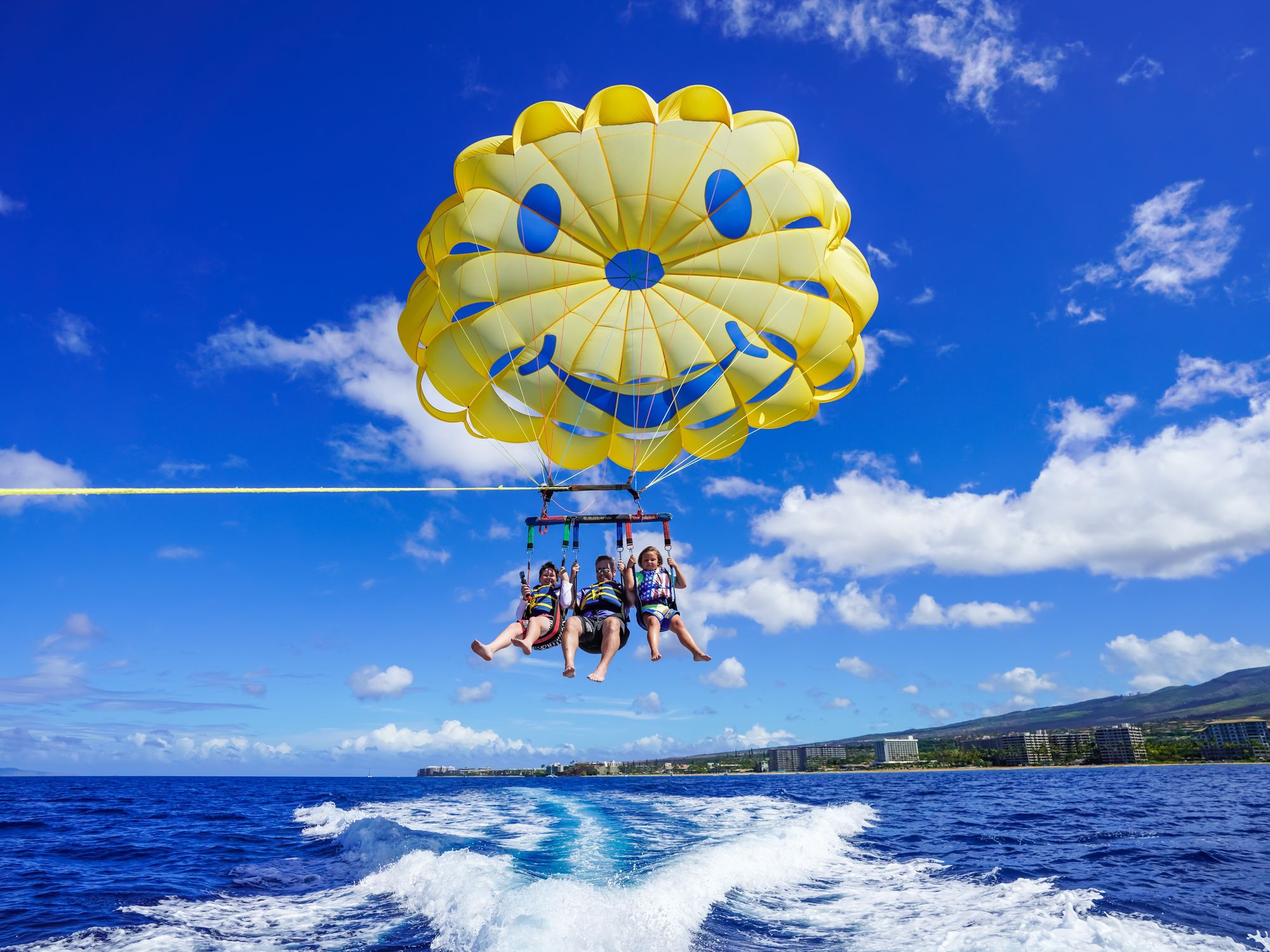
Flight line is the one everyone quotes. We fly up to 1,200 feet of it, which is the longest line flown on this stretch of coast, and from the top you get the full run of the shoreline: the resort strip and Black Rock below, Lahaina down the coast, Lānaʻi and Molokaʻi across the channel.
Time in the air is the number to ask about as well. Ours runs 8–14 minutes, depending on the weather, and the boat runs a loop of the coast while you're up. The whole trip is about 1 hour, depending on how many flyers are aboard.
How many people are on the boat
Flights are shared, so you'll be aboard with other guests. Our two newest boats carry up to 12 passengers, and flights run continuously through the session. Non-flyers can ride along, which is often the best seat for photos. If you'd rather have the whole boat for a family group or a celebration, a private tour takes the whole trip.
Who can fly together
Between 1–3 people go up on each parasail. Solo needs a minimum of 130 lb; tandem runs 125–560 lb combined; triple puts three under one canopy. Ages 5 and up, no upper limit, and the crew sorts the pairings on the boat once they can see the group. The weight and age limits have the detail.
The water underneath you
This is the part no brochure explains. Kaanapali sits in the lee of the West Maui Mountains, which is why the water here is glass most mornings while the rest of the island is working. That protection is what makes a 1,200-foot flight comfortable rather than sporty — the lift is gradual, there's almost no wind in your face, and the engine noise falls away behind you.
Whoever you fly with, book a morning. The water is calmest early and visibility across to Lānaʻi and Molokaʻi is usually clearest before the trade winds build. Later departures still fly; they just have more texture.
Season
Maui's parasail season runs May 16 to December 14. Every operator shuts down for the winter while the humpback whales are in the channel, so if you're here between December 14 and May 16, nobody is flying — and anyone who says otherwise is worth asking questions of. Summer through early fall is the busiest stretch; May and December are quieter, with the same flight and shorter waits. The season guide covers it month by month.
What a good operator will tell you without being asked
Who is driving the boat, and what the weather policy is. Every one of our flights is run by USCG-certified captains on equipment inspected and maintained on schedule; we are members of the Water Sports Industry Association and follow the ASTM standards for parasailing. If the wind isn't right we don't fly marginal conditions — you're rescheduled at no charge or refunded in full. The crew speaks English, Spanish and Japanese, and takeoff and landing both happen on the deck, so you stay dry unless you ask for a dip.
Why Kaanapali
Put the list together and it points at this beach: protected water in the lee of the mountains, a launch from the sand rather than a harbor, 1,200 feet of line with 8–14 minutes to enjoy it, and the view across the channel that the altitude is for. Parasailing on Kaanapali Beach has the whole flight laid out, and what to expect on your first flight walks through the hour step by step.